Call us:



Many students ask one honest question before starting their study abroad journey: How long does it take to prepare for IELTS? This question looks simple, but the answer is not the same for every student. A student from Dhaka who studied in an English medium school may need less time than a student from a Bangla medium background in a rural area. A student who reads English newspapers, watches English videos, and writes in English often may improve faster. Another student may understand grammar but feel nervous in speaking. So, How long does it take to prepare for IELTS depends on your present English level, target band score, daily study time, guidance, confidence, and exam strategy.
A fair answer is this: most Bangladeshi students need 2 to 6
months to prepare well for IELTS. Students with a strong English base may need
4 to 8 weeks. Students aiming for band 7 or above may need 3 to 6 months.
Students with weak grammar, poor vocabulary, or fear of speaking may need more
time. The real issue is not only time. The real issue is how wisely you use
that time.
Understanding the IELTS Journey Before Counting the Months
Before asking How long does it take to prepare for IELTS,
you should first understand what IELTS actually tests. IELTS checks four
skills: Listening, Reading, Writing, and Speaking. Many Bangladeshi students
think IELTS is only about grammar. This is a common mistake. Grammar matters,
but IELTS is more about communication.
For example, Rafi, a student from Mirpur, had good grammar.
He could solve many grammar exercises. But when he started IELTS Writing Task
2, he could not organize ideas clearly. He wrote long sentences, but the
meaning was not strong. His teacher told him, “IELTS is not about showing
difficult English. It is about showing clear English.” After two months of
regular writing practice, his writing became simple, clean, and logical.
This is why preparation time varies. If your problem is only
test format, you may need a short time. If your problem is basic English, you
need a longer plan.
A good IELTS preparation plan should include:
- Understanding
the test format
- Building
vocabulary for common topics
- Practicing
listening with different accents
- Improving
reading speed
- Learning
essay structure
- Practicing
speaking with feedback
- Taking
mock tests
- Reviewing
mistakes carefully
So, the best answer is not a fixed number of days. The best
answer is a realistic preparation path based on your starting point.
How long does it take to prepare for IELTS for Beginners?
For beginners, IELTS preparation usually takes 4 to 8
months. A beginner is not someone who knows no English at all. In Bangladesh,
many students can read English but cannot use it smoothly. They may understand
school-level English but struggle with academic articles, formal writing, and
fluent speaking.
Think about Mitu from Rangpur. She completed HSC from a
Bangla medium college. Her dream was to study nursing in the UK. At first, she
could understand simple English, but IELTS Listening felt too fast. Reading
passages looked too long. Speaking made her nervous because she was afraid of
making mistakes. She started with basic grammar, daily vocabulary, and short
speaking practice. After three months, she moved to IELTS format practice.
After six months, she reached an overall band 6.5.
For beginners, the biggest challenge is patience. Many
students want a band 7 in one month, but they have not written an English essay
for years. That is not impossible for everyone, but it is not realistic for
most.
Beginners should follow this timeline:
- First 1 to 2 months: Build basic grammar, sentence
structure, and vocabulary.
- Next 2 months: Learn IELTS question types and start
skill-based practice.
- Next 1 to 2 months: Take mock tests, correct mistakes, and
improve weak areas.
- Final month: Practice under exam conditions and polish
strategies.
If you are a beginner, do not feel ashamed. Many successful
students started from a weak position. What matters is regular practice.
How long does it take to prepare for IELTS for Intermediate
Students?
Intermediate students usually need 2 to 4 months. These
students can understand English, write basic paragraphs, and speak in simple
sentences. But they may not know how to answer IELTS questions properly.
For example, Tanvir from Chattogram had an overall English
level around band 5.5. He watched English movies and understood lectures, but
his Writing Task 2 score stayed low. His ideas were good, but his paragraphs
were not connected. He practiced planning essays for 10 minutes before writing.
He learned how to write topic sentences and examples. In three months, he
reached band 6.5.
Intermediate students often make these mistakes:
- They
write too much but do not answer the question.
- They
memorize speaking answers and sound unnatural.
- They
read slowly and lose time.
- They
ignore spelling mistakes in Listening.
- They
do mock tests but do not review errors.
For intermediate students, preparation should not be random.
They need targeted practice. If Reading is already strong, they should not
spend the same amount of time on Reading as Writing. If Speaking is weak, they
should record their voice daily.
A good 3-month plan can work well for intermediate students.
Month one should focus on format and basic strategies. Month two should focus
on deep practice. Month three should focus on mock tests and band improvement.
How long does it take to prepare for IELTS for Band 7 or
Higher?
Students aiming for band 7 or higher usually need 3 to 6
months, depending on their current level. Band 7 means you are a good user of
English. You can communicate well, but you may still make some mistakes. For
many universities, professional bodies, and scholarship plans, band 7 can be
very important.
Now let us look at a real-life style example. Nusrat from
Dhanmondi wanted to apply for a Master’s program in Canada. Her first mock test
score was 6.0. She needed 7.0 overall, with no band below 6.5. Her Reading and
Listening were strong, but Writing was 6.0. She spent four months working on
essay planning, grammar accuracy, and task response. She also practiced
Speaking with a partner three times a week. Finally, she got 7.0 overall.
For band 7, you cannot depend on memorized templates only.
You need flexible language. You need topic knowledge. You need to understand
the question deeply. You also need to avoid repeated grammar mistakes.
Band 7 preparation should include:
- Daily
reading from reliable English sources
- Practice
with Cambridge-style tests
- Writing
feedback from a trained mentor
- Speaking
practice with follow-up questions
- Vocabulary
learning by topic
- Error
correction notebook
- Weekly
mock tests
Students often ask, “Can I get band 7 in one month?” The
honest answer is yes, but only if your current level is already close to band
6.5 or 7. If your current level is around band 5, one month is usually not
enough.
IELTS Preparation Time Based on Daily Study Hours
Your daily study time changes the full preparation period. A
student who studies 4 hours daily will progress faster than a student who
studies 45 minutes daily. But quality matters more than long hours. Four
distracted hours are less useful than two focused hours.
Here is a practical idea:
- If you study 1 hour daily, you may need 5 to 8 months.
- If you study 2 hours daily, you may need 3 to 5 months.
- If you study 3 hours daily, you may need 2 to 4 months.
- If you study 4 or more focused hours daily, you may prepare
in 1.5 to 3 months if your base is not too weak.
Many Bangladeshi students are busy with classes, tuition,
office work, or family duties. So they cannot always study for long hours. In
that case, small habits help. Listen to English while commuting. Read one
article before sleeping. Write one paragraph after Fajr or before dinner. Speak
for five minutes with a friend.
Consistency is more powerful than one big study day. A
student who studies 90 minutes every day for three months often does better
than a student who studies eight hours only on weekends.
Common Challenges Faced by Bangladeshi IELTS Candidates
IELTS preparation in Bangladesh has some special challenges.
These challenges are not excuses. They are real conditions that students must
plan around.
- The first challenge is financial pressure. IELTS
registration fees, coaching costs, mock tests, books, and application fees can
create stress. Many families spend from savings. Some students feel guilty if
they fail once. This pressure affects confidence.
- The second challenge is speaking fear. Many students
understand English but feel shy speaking in front of others. In our culture,
people often laugh when someone makes a mistake in English. This creates fear.
But IELTS Speaking is not a public speech. It is a conversation. You can
improve by practicing daily with a friend, teacher, or even by recording
yourself.
- The third challenge is writing weakness. Bangladeshi
students often learn English through memorization. IELTS Writing needs opinion,
logic, and clear structure. Memorized essays do not work well.
- The fourth challenge is lack of exposure to accents. IELTS
Listening may include British, Australian, Canadian, or other accents. Students
who only hear local classroom English may struggle at first.
- The fifth challenge is time management. Many students can
answer questions correctly but not within the time limit. Reading is especially
difficult because passages are long and questions are tricky.
Practical advice is simple. Start early. Use free resources
wisely. Take mock tests. Do not hide your weakness. Get feedback. Avoid fake
shortcuts. IELTS rewards skill, not panic.
A Practical 90-Day IELTS Preparation Plan
For many students, 90 days is a balanced time. It is not too
short, and it is not too long. If you ask How long does it take to prepare for
IELTS with a serious but realistic mindset, a 90-day plan can be a strong
answer.
- Days 1 to 15 should focus on diagnosis. Take one full mock
test. Find your weak areas. Learn the test format. Start a vocabulary notebook.
Read simple English articles daily.
- Days 16 to 40 should focus on skill building. Practice
Listening section by section. Learn Reading question types. Write Task 1 and
Task 2 regularly. Speak on common topics like family, education, work,
hometown, technology, and travel.
- Days 41 to 70 should focus on exam strategy. Practice under
time limits. Review every wrong answer. Learn how to paraphrase. Improve essay
examples. Record speaking answers and check fluency.
- Days 71 to 90 should focus on mock tests and correction.
Take at least one full mock test every week. Work on your weakest module.
Reduce common mistakes. Sleep well before the exam. Do not learn too many new
tricks at the last moment.
This plan works best when students study 2 to 3 hours daily.
If your English base is weak, extend the plan to 120 or 180 days.
How to Prepare for Each IELTS Module
- Listening preparation may take 4 to 8 weeks for many
students. You need to understand question types, spelling, plural words,
numbers, maps, and distractors. A distractor is when the speaker gives one
answer and then changes it. Many students lose marks there.
- Reading preparation may take 6 to 10 weeks. You need speed,
scanning, skimming, and patience. Do not read every word in the same way. Learn
to find information quickly. Practice True, False, Not Given carefully because
it confuses many students.
- Writing preparation often takes the longest time. Many
students need 2 to 4 months only to improve Writing. You need task response,
coherence, vocabulary, grammar, and clear examples. Do not write memorized
lines. Write simple but accurate sentences.
- Speaking preparation can improve in 1 to 3 months with
regular practice. The biggest task is to become natural. Speak in complete
answers. Give examples from your life. Do not try to sound like a native
speaker. Try to sound clear, confident, and honest.
Each module needs a different method. So, your total
preparation time depends on which module is weakest.
The Role of Coaching, Self-Study, and Mock Tests
Some students can prepare by themselves. Others need
coaching. There is no single rule. If you are disciplined, understand English
well, and can find good resources, self-study may work. But if you do not
understand your mistakes, coaching can save time.
A good teacher does not only give lectures. A good teacher
shows why your answer is wrong. For Writing and Speaking, feedback is very
important. You may write ten essays and repeat the same mistake ten times. One
honest review can help you improve faster.
Mock tests are also important. Many students study for
months but do not take full tests. Then, on exam day, they feel shocked by the
pressure. Mock tests train your mind and body for the real exam.
However, do not take mock tests every day without review.
That is like checking fever again and again without taking medicine. Review is
the medicine.
A smart routine is:
- Learn
a skill
- Practice
that skill
- Take a
small test
- Review
mistakes
- Repeat
the same question type
- Take a
full mock test later
This method saves time and builds confidence.
IELTS Preparation and the Study Abroad Dream
IELTS preparation is often the first serious step toward
studying abroad. For Bangladeshi students, this step may feel emotional.
Parents may ask every day, “How is your preparation?” Relatives may compare you
with others. Friends may already have visas. Social media may make you feel
late.
But your IELTS journey is your own. A student who gets band 6.5 after five months is not a failure. A student who needs two attempts is not weak. A student who starts from Bangla medium and reaches band 7 has shown real courage.
IELTS is accepted widely by universities, employers, and
immigration bodies around the world. So, it is worth taking seriously. But it
should not destroy your mental peace. Prepare with discipline, but also take
care of your sleep, food, and emotional health.
Final Answer: How long does it take to prepare for IELTS?
So, How long does it take to prepare for IELTS? In simple
words, it usually takes 2 to 6 months for most students. Beginners may need 4
to 8 months. Intermediate students may need 2 to 4 months. Advanced students
may need 4 to 8 weeks. Band 7 seekers may need 3 to 6 months if they are not
already close to the target.
The best preparation time depends on five things: your
current English level, target band, daily study time, learning method, and
feedback quality. If you study regularly, review mistakes, and practice all
four modules, you can reach your target faster.
Remember, IELTS is not a race against others. It is a
journey toward your own future.
Summary
How long does it take to prepare for IELTS depends on your
English level, target score, study routine, and guidance. Most Bangladeshi
students need 2 to 6 months. Beginners may need more time, while strong
students may need less. The smartest plan is to start with a mock test, find
weak areas, study regularly, take feedback, and practice under exam conditions
before booking the final test.
FAQs
1. How long does it take to prepare for IELTS if I am
from Bangla medium?
- If you are from Bangla medium, you may need 4 to 6 months in
most cases.
- This does not mean Bangla medium students are weak.
- It means you may need more time to build fluency and
academic writing habits.
- Start with grammar, vocabulary, listening practice, and
simple speaking.
- Then move to IELTS question types and mock tests.
- Many Bangla medium students have achieved band 7 or higher
with regular practice.
2. Can I prepare for IELTS in one month?
- Yes, you can prepare in one month if your English level is
already strong.
- If you already score around band 6.5 in mock tests, one
month may be enough for strategy.
- But if your level is around band 4.5 or 5, one month is
usually too short.
- In that case, you may learn the format but not improve
deeply.
- Use one month for intensive practice only when your base is
good.
- Otherwise, choose a longer plan to avoid wasting exam fees.
3. How many hours should I study daily for IELTS?
Most students should study 2 to 3 focused hours daily.
- One hour can work if you start early and study for several
months.
- Four hours can work for students who have a short deadline.
- But long study hours without review are not very useful.
- You should divide time among Listening, Reading, Writing,
and Speaking.
- Try to keep at least 30 minutes daily for vocabulary and
error correction.
4. Which IELTS module takes the longest time to improve?
- For many Bangladeshi students, Writing takes the longest
time.
- This is because IELTS Writing needs structure, logic,
grammar, and clear examples.
- Many students know English but cannot organize ideas well.
- Speaking can also take time if the student is shy or has low
confidence.
- Listening and Reading often improve faster with regular
practice.
- Still, every student is different, so a diagnostic mock test
is important.
5. Is coaching necessary for IELTS preparation?
- Coaching is not always necessary, but it can be very
helpful.
- If you can study alone and understand your mistakes,
self-study may be enough.
- But Writing and Speaking usually need expert feedback.
- A teacher can show mistakes that you may not notice
yourself.
- Coaching also helps students stay disciplined and follow a
routine.
- Choose coaching based on quality, not only popularity or
advertisements.
6. When should I book my IELTS exam?
- You should book your exam when your mock test scores are
close to your target.
- Do not book only because your friends are booking.
- If your target is 6.5, try to score 6.5 or 7 in practice
tests first.
- This gives you confidence and reduces the risk of retaking
the exam.
- Also consider university deadlines and visa timelines.
- Booking too early can create pressure and lead to poor
performance.
7. Can I get band 7 without speaking English every day?
- It is difficult, but not impossible.
- Speaking improves when you use English regularly.
- You do not need to speak for hours every day.
- Even 10 to 15 minutes of daily speaking can help a lot.
- Record your answers and listen to your fluency, grammar, and
pronunciation.
- If you have no partner, speak alone on common IELTS topics.
8. How can I prepare for IELTS with a low budget?
- You can use free online resources, library books, and group
practice.
- Many students prepare with Cambridge IELTS books and free
listening materials.
- You can form a speaking group with friends.
- For Writing, try to get feedback from a teacher at least
once in a while.
- Avoid buying too many random courses or materials.
- A simple plan followed regularly is better than expensive
but unused resources.
9. What is the best IELTS preparation plan for university
students?
- University students should follow a flexible weekly plan.
- They can study 1 to 2 hours on class days and more on
weekends.
- They should use semester breaks for mock tests and writing
practice.
- Listening can be practiced while traveling to campus.
- Speaking can be practiced with classmates after class.
- The key is to avoid waiting until the final application
deadline.
10. Why do many students fail to improve their IELTS
score?
- Many students fail because they practice without
understanding mistakes.
- They take many mock tests but do not review wrong answers.
- Some memorize essays and speaking answers, which sounds
unnatural.
- Some ignore Writing because it feels difficult.
- Others study irregularly and expect fast results.
- Improvement comes from feedback, correction, repetition, and
patience.
11. Is IELTS harder for Bangladeshi students?
- IELTS is not designed to be harder for Bangladeshi students.
- But Bangladeshi students may face some local challenges.
- These include less speaking practice, memorization-based
learning, and accent problems.
- Financial pressure can also make the exam feel more
stressful.
- With the right plan, these challenges can be managed.
- Many Bangladeshi students achieve excellent IELTS scores
every year.
12. Should I focus more on grammar or vocabulary?
- You need both grammar and vocabulary, but balance is
important.
- Grammar helps you write and speak accurately.
- Vocabulary helps you explain ideas clearly.
- Do not memorize rare or difficult words only to impress
examiners.
- Learn useful topic-based words and practice them in
sentences.
- Simple and correct English is better than complex but wrong
English.
13. How many mock tests should I take before IELTS?
- You should take at least 5 to 8 full mock tests before the
real exam.
- If your target score is high, you may need more.
- Mock tests help you understand timing, pressure, and weak
areas.
- But do not take mock tests without checking mistakes.
- After every mock test, spend time reviewing your answers.
- The review process often improves your score more than the
test itself.
14. Can I prepare for IELTS while working full time?
- Yes, many working students prepare for IELTS successfully.
- You need a realistic plan, not a perfect plan.
- Study 60 to 90 minutes on weekdays and more on weekends.
- Use travel time for listening practice if possible.
- Write essays on holidays and get feedback regularly.
- A 4 to 6 month timeline is often better for full-time
workers.
15. What is the final advice for IELTS candidates in
Bangladesh?
- Start early and know your current level before making a
plan.
- Do not compare your journey with others.
- Use trusted materials and avoid fake shortcuts.
- Practice all four modules and give extra care to Writing and
Speaking.
- Take mock tests under real timing before booking the exam.
- Most importantly, believe that steady practice can change
your result.
Find Your Courses
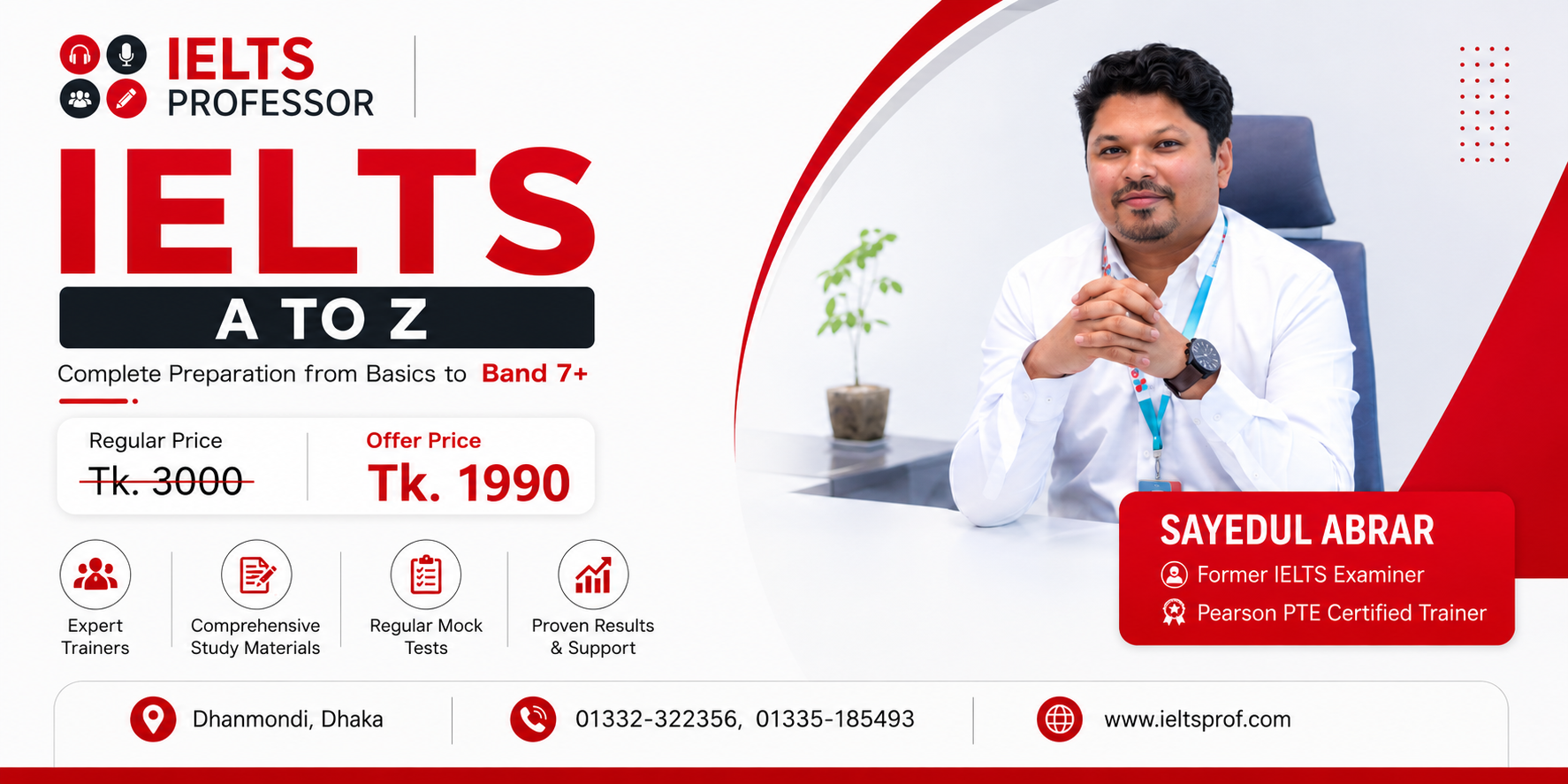
IELTS A to Z
৳ 1990.00
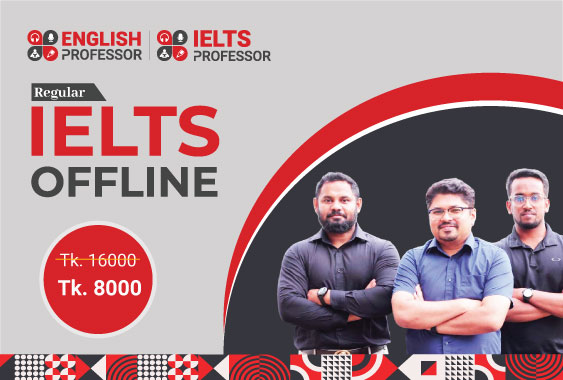
7+ IELTS Offline Regular
৳ 8000.00
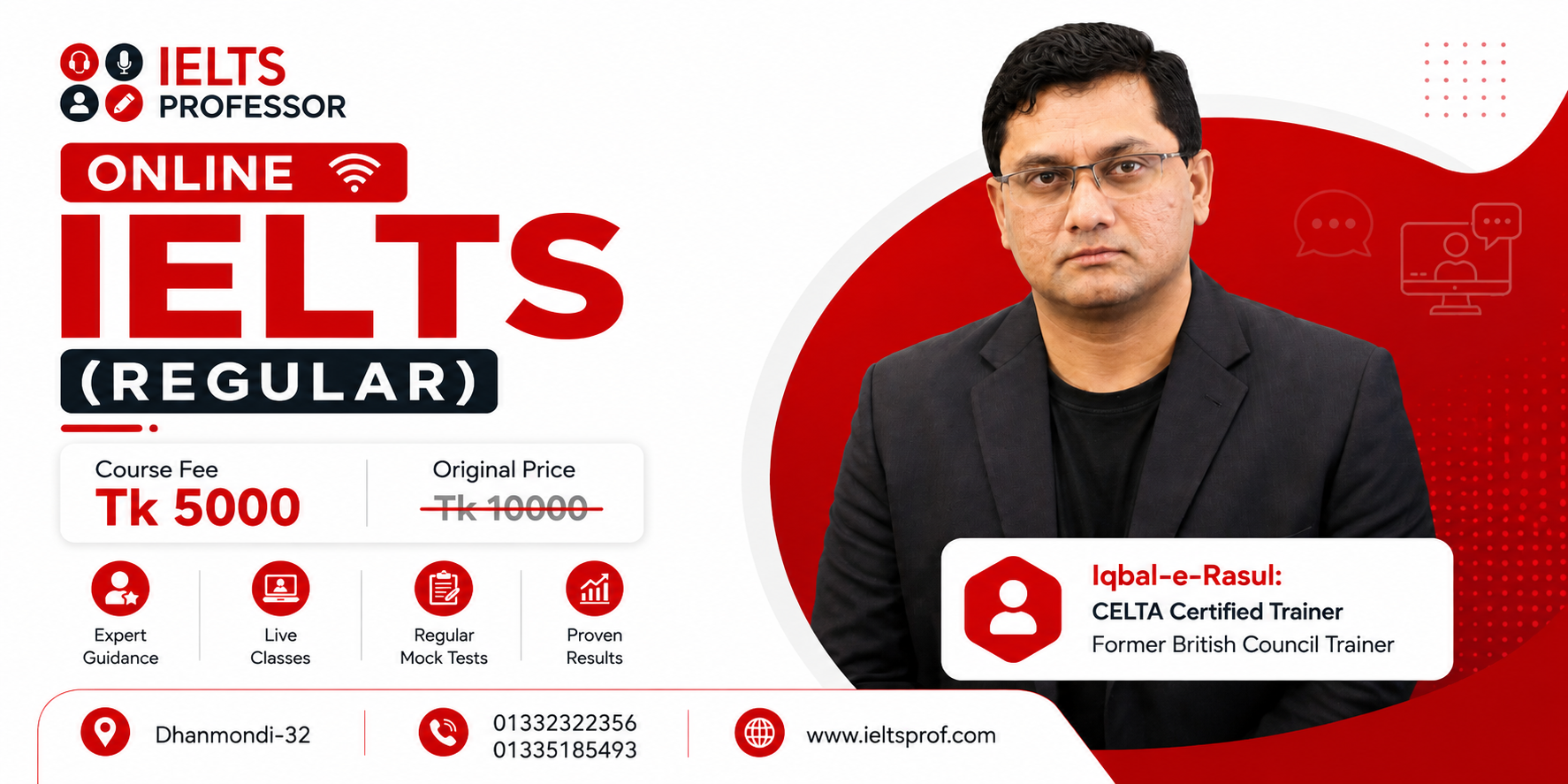
Online IELTS (Regular)
৳ 5000.00
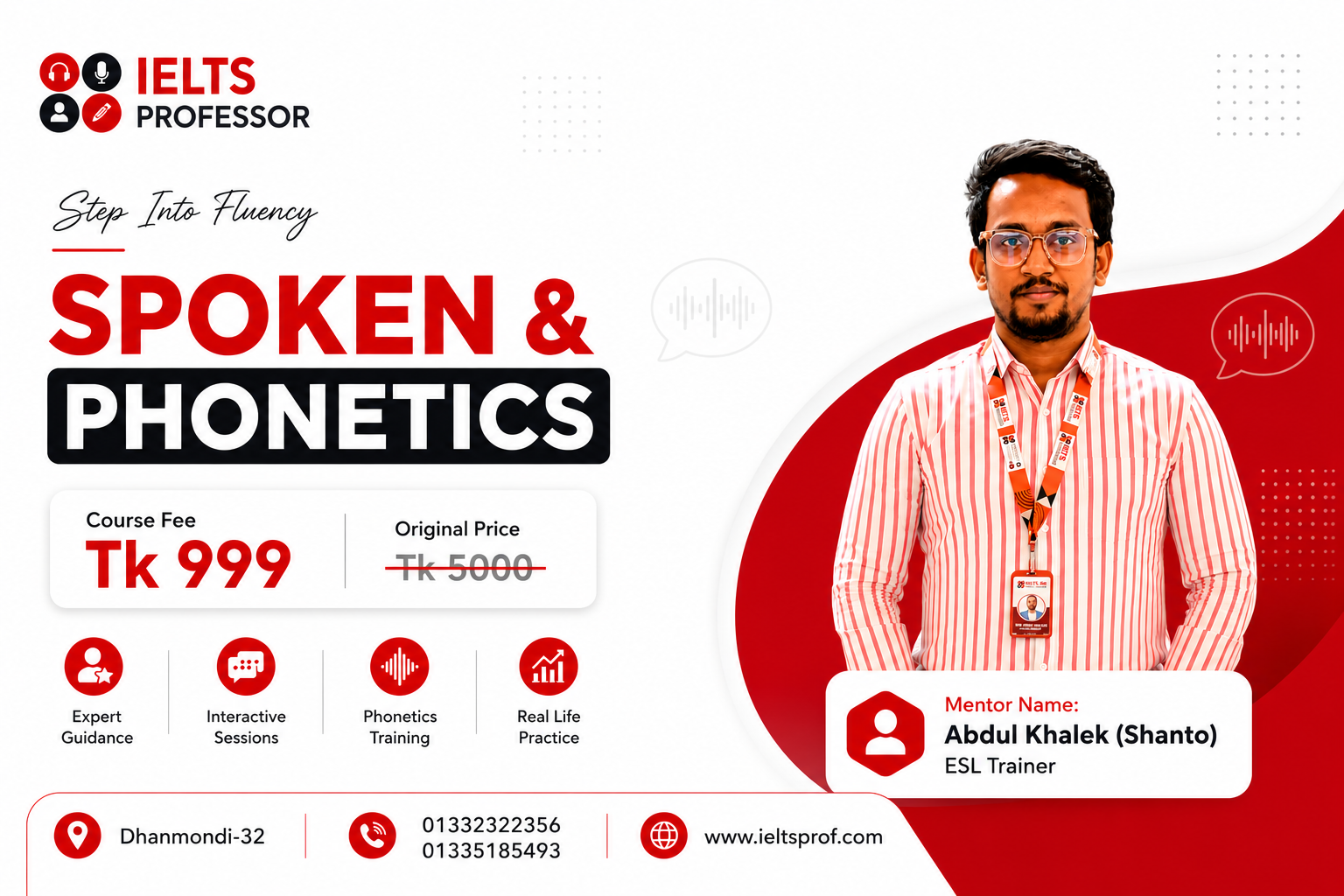
Spoken English
৳ 3500.00
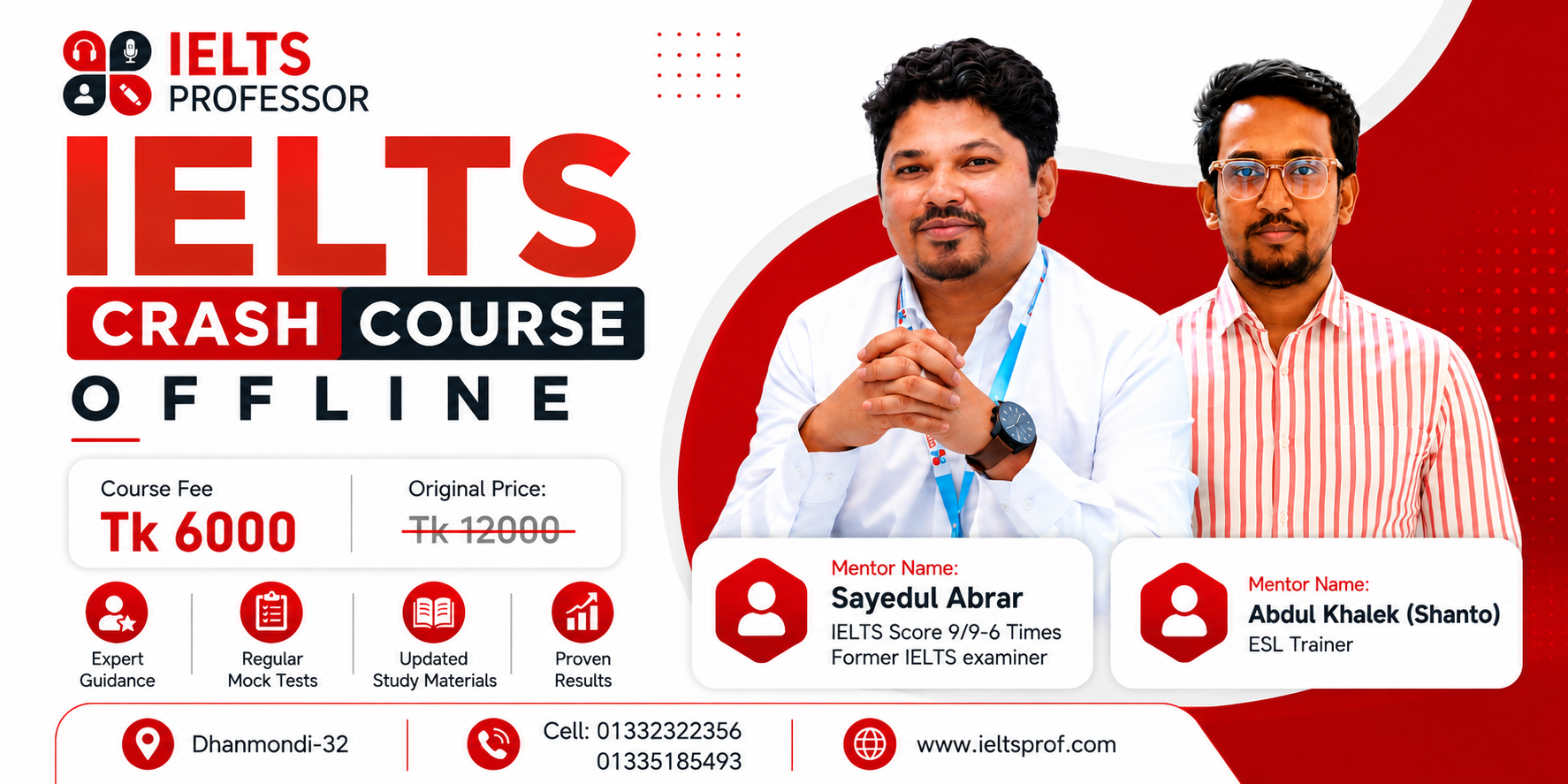
IELTS Regular Executive
৳ 8000.00
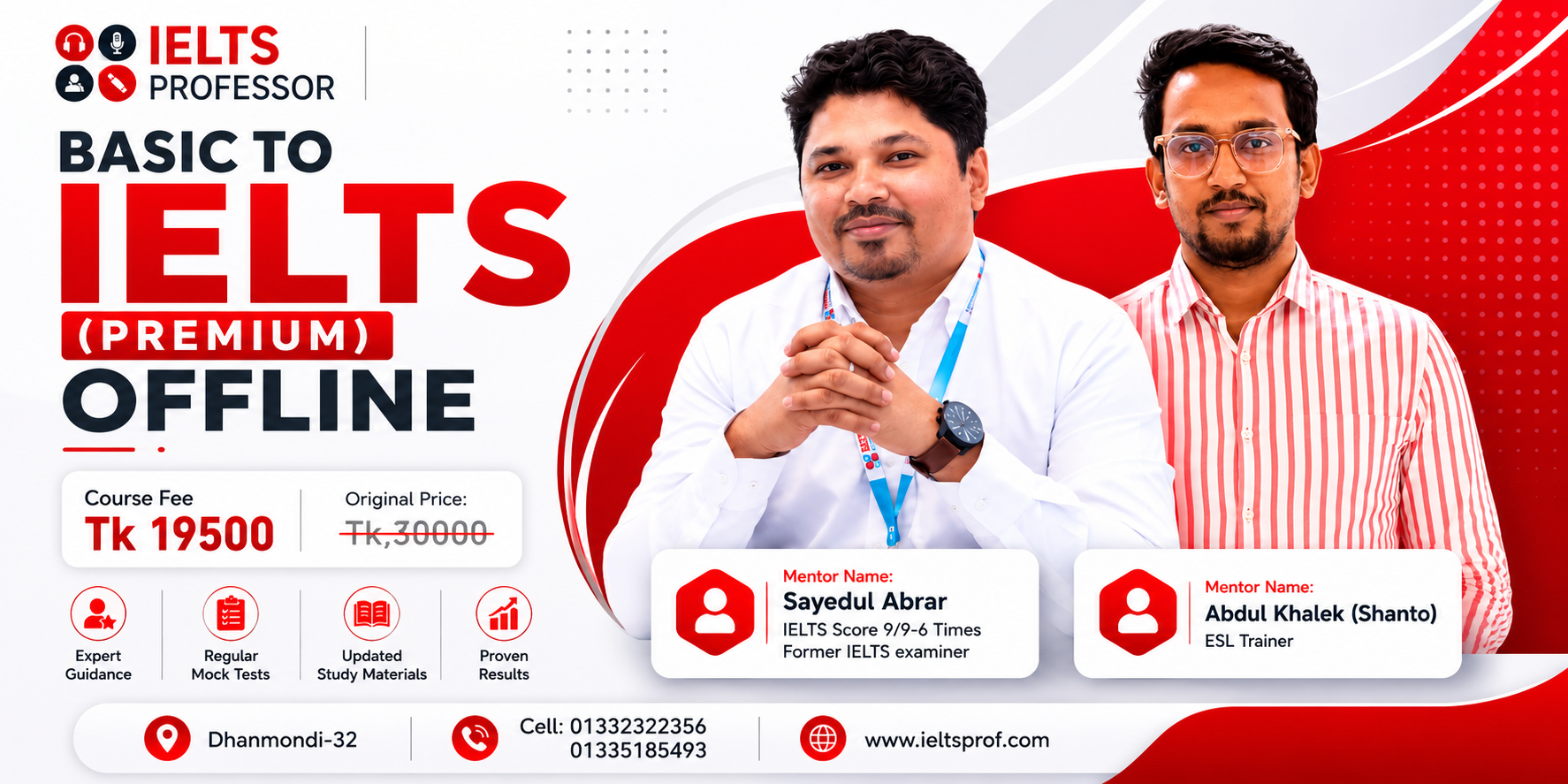
Basic to IELTS
৳ 19500.00
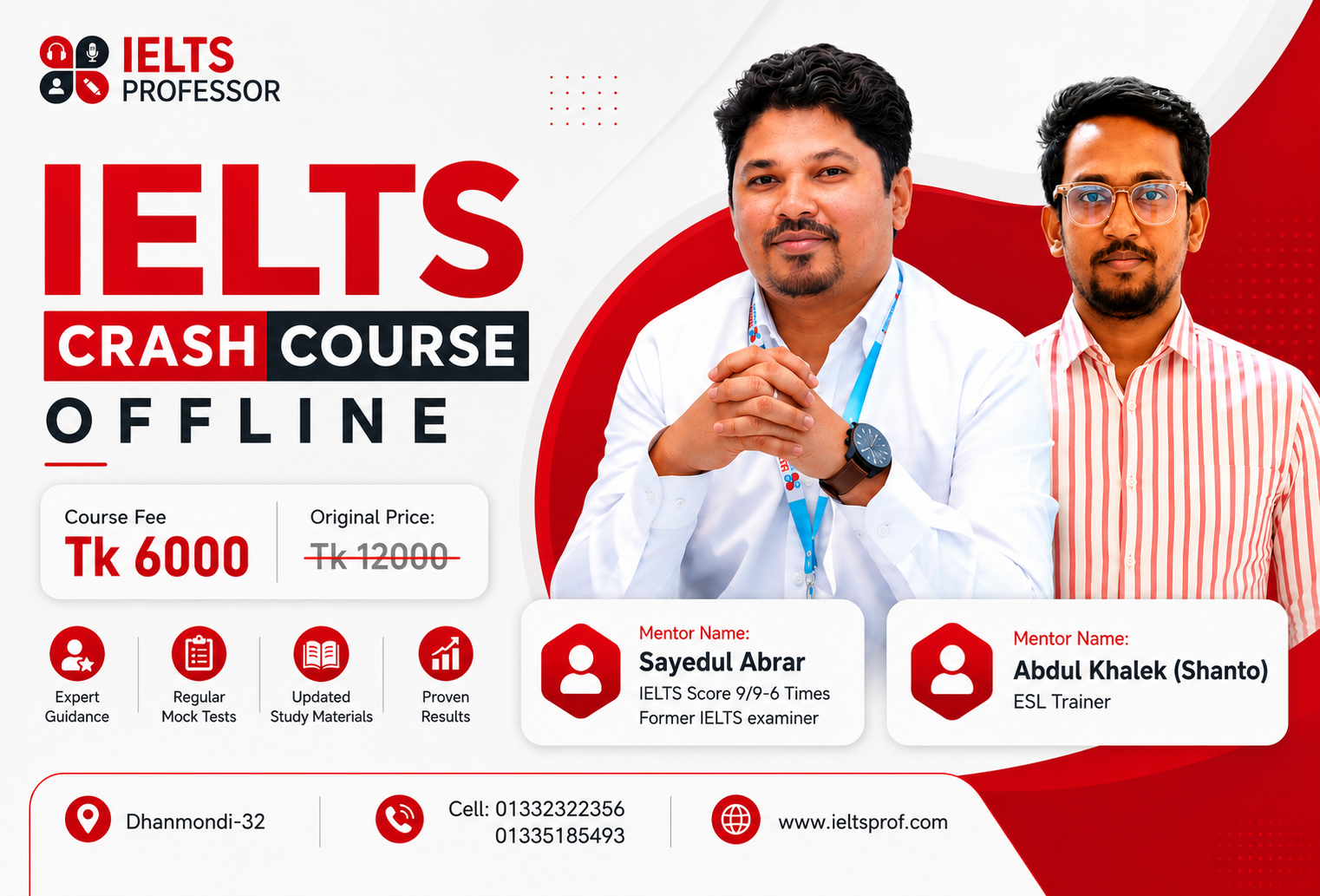
IELTS Crash Course
৳ 6000.00
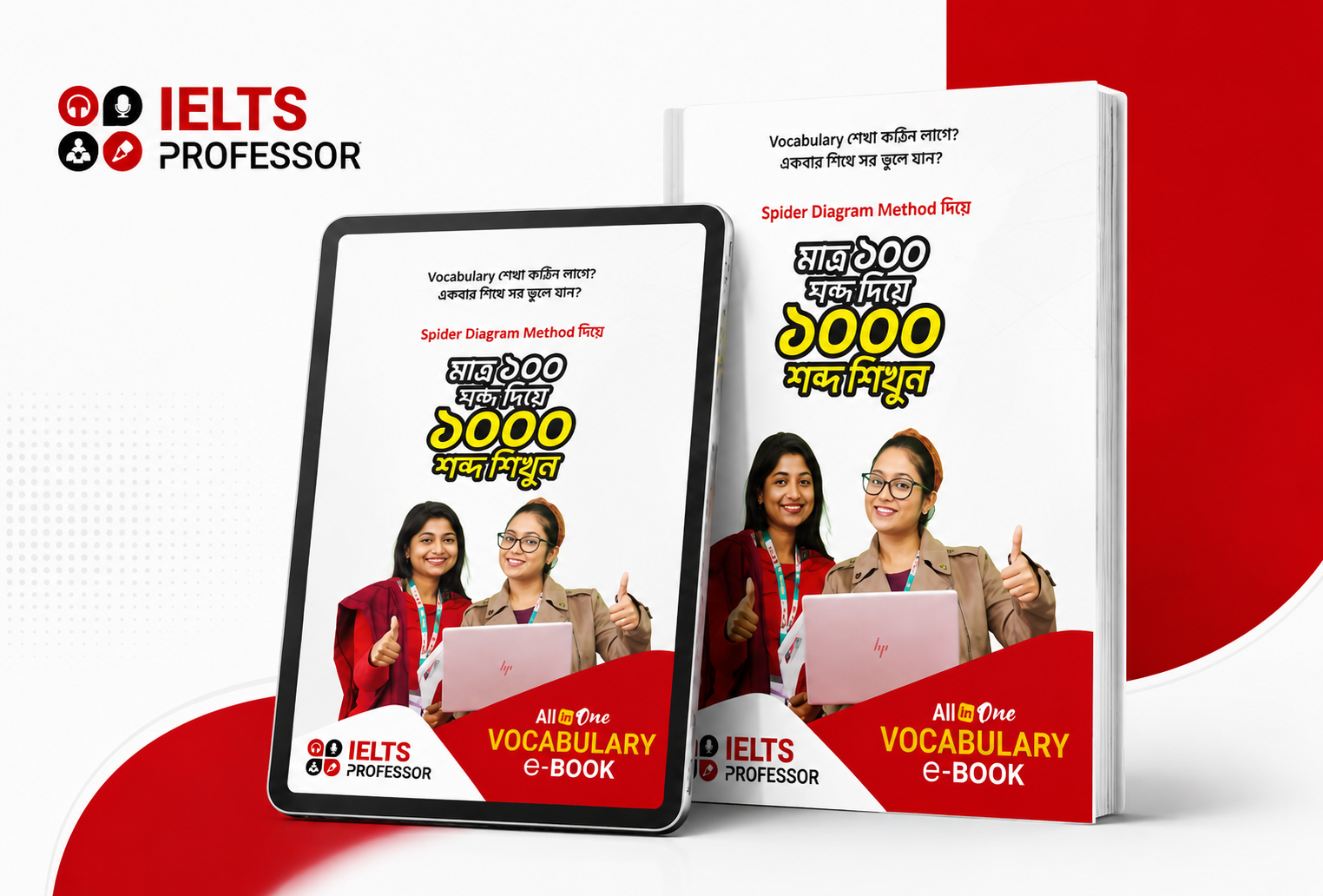
All in One Vocabulary
৳ 249.00

Premium 7+ IELTS Offline
৳ 14000.00