Call us:



Many students know English grammar, understand common vocabulary, and can communicate reasonably well, yet they still receive a lower score in IELTS Writing. This situation often creates confusion. A learner may ask, “I wrote more than 300 words, so why did I receive Band 5.5?” Another student may use many difficult words but remain stuck at Band 6. These experiences show that learning How to improve IELTS writing band score requires more than writing long answers or memorising impressive phrases.
For Bangladeshi students, the journey can be difficult for
several reasons. Many learners complete years of school without receiving
regular feedback on English essays. They may know grammar rules but have little
experience in developing an argument. Some translate directly from Bangla.
Others memorise fixed templates from coaching notes or social media videos.
Financial pressure may also prevent students from taking private lessons or
repeated mock tests.
This guide explains How to improve IELTS writing band score
through realistic methods rather than shortcuts. It discusses scoring criteria,
planning, paragraph development, vocabulary, grammar, practice routines,
feedback, mock tests, and common cultural and educational challenges. It also
includes stories of Bangladeshi learners who gradually improved their writing
through disciplined and intelligent preparation.
Understand What IELTS Writing Examiners Actually Assess
Before trying to improve your score, you must understand how
your answer is evaluated. Many students practise without studying the scoring
system. As a result, they repeat the same mistakes for months.
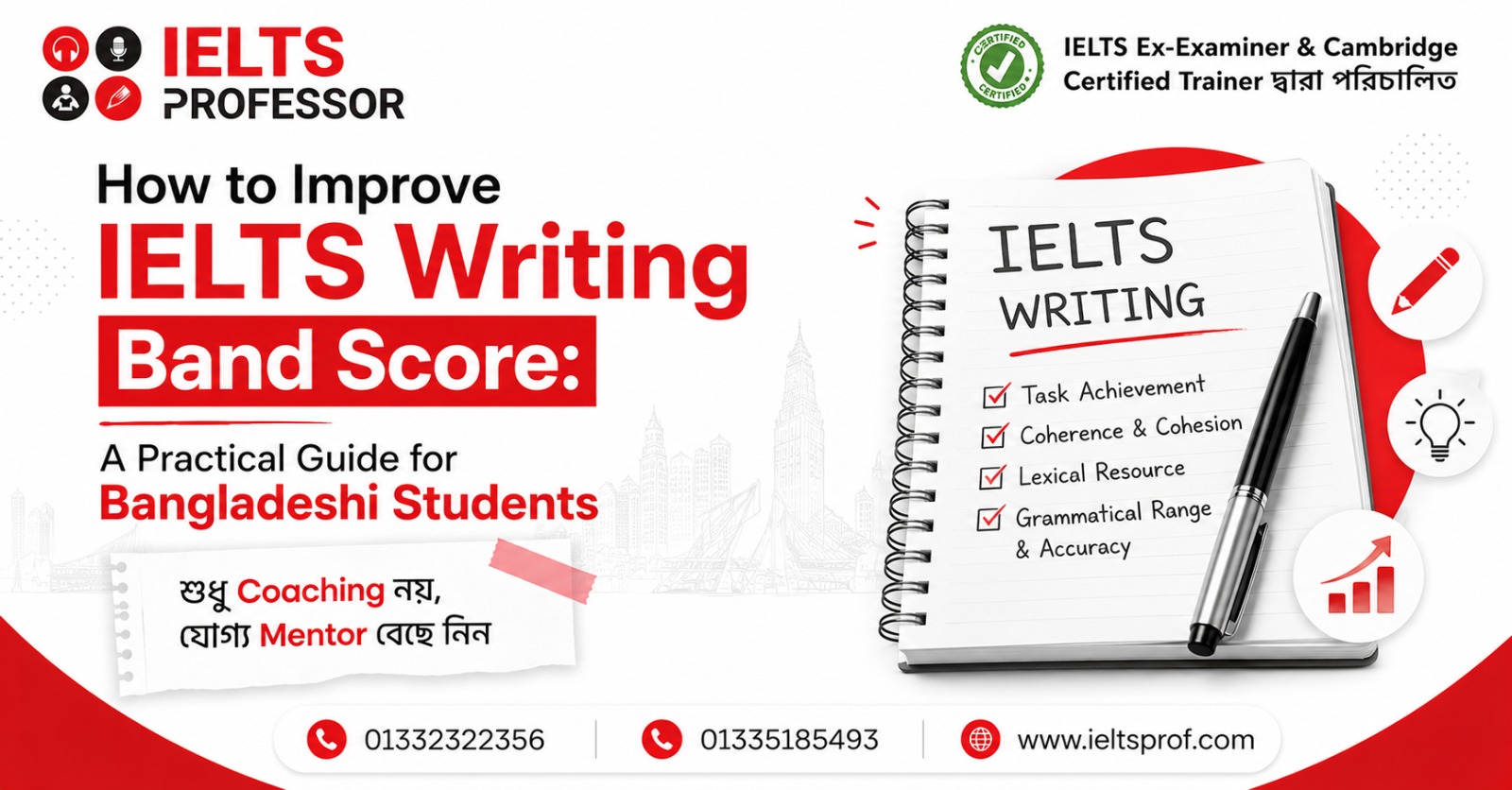
IELTS Writing is assessed through four main criteria:
- Task
Achievement or Task Response
- Coherence
and Cohesion
- Lexical
Resource
- Grammatical
Range and Accuracy
Each task is marked independently. Task 1 uses Task Achievement, while Task 2 uses Task Response. The other three criteria apply to both tasks.A good answer must therefore do several things together. It must answer the question, present relevant information, organise ideas, use suitable vocabulary, and maintain grammatical control.
A candidate cannot fully compensate for a weak response by
using difficult words. Similarly, an essay with perfect grammar may still
receive a moderate score if it does not answer all parts of the question.
Understanding this balance is the first major lesson in Howto improve IELTS writing band score.
Know the IELTS Writing Test Format
The IELTS Academic and General Training Writing tests both
contain two tasks and last for 60 minutes.
For Academic Writing:
- Task
1 usually requires a report describing visual information such as a graph,
table, chart, map, process, or diagram.
- Task
2 requires an essay responding to an opinion, argument, issue, or problem.
For General Training Writing:
- Task
1 requires a letter.
- Task
2 requires an essay.
Candidates should generally spend about 20 minutes on Task 1
and 40 minutes on Task 2. Task 1 requires at least 150 words, while Task 2
requires at least 250 words. Task 2 contributes twice as much as Task 1 to the
Writing result.
This weighting matters. A student who spends 35 minutes
making Task 1 perfect may have too little time for Task 2. That can reduce the
overall Writing score.
Start by Identifying Your Real Weakness
Many students say, “My writing is weak,” but this statement
is too general. You need to know exactly what is weak.
Your difficulty may involve:
- Misunderstanding
the question
- Producing
irrelevant ideas
- Writing
weak introductions
- Failing
to develop body paragraphs
- Using
memorised vocabulary
- Making
frequent grammar errors
- Repeating
the same words
- Writing
without clear paragraphing
- Running
out of time
- Failing
to proofread
Take a complete timed Writing test before creating a study
plan. Ask a qualified teacher to evaluate it according to the official
criteria.
Suppose your grammar is reasonably accurate, but your body
paragraphs contain only general statements. In that case, spending all your
time memorising grammar rules will not solve the main problem. You need to
practise explaining and supporting ideas.
A proper diagnosis saves time, effort, and money.
How to Improve Task Response
Task Response measures how completely and appropriately you
answer Writing Task 2. It considers whether you address all parts of the
prompt, present a clear position, and develop relevant ideas.
Imagine this question:
Some people believe that university education should be free
for everyone. To what extent do you agree or disagree?
A weak candidate may write generally about the importance of
education without clearly saying whether university education should be free.
This may produce grammatically acceptable writing, but the response does not
fully answer the question.
A stronger approach would include:
- A
clear opinion in the introduction
- Two
main reasons supporting that opinion
- Detailed
explanations
- Relevant
examples
- A
conclusion that restates the position
IELTS states that Task Response includes how well a
candidate develops an argument and supports it with evidence and examples.
Those examples may come from personal experience.
Do not begin writing immediately. Spend three to five
minutes analysing the question.
Underline:
- The
main topic
- The
instruction words
- Any
limits or specific groups
- The
number of questions you must answer
This small habit can prevent a major scoring problem.
Develop Ideas Instead of Listing Them
A common problem among Bangladeshi candidates is presenting
many ideas without explaining any of them.
Consider this weak paragraph:
- Studying abroad is beneficial because students receive
better education, meet new people, learn new cultures, find jobs, become
independent, and improve their English.
- The paragraph contains several claims, but none is
developed.
- A stronger paragraph may focus on one main idea:
Studying abroad can help young people become more
independent. Many students must manage their own budget, prepare food, attend
classes, and solve daily problems without direct support from their families.
For example, a Bangladeshi student living in Australia may initially struggle
with transport and household responsibilities. However, managing these tasks
can gradually improve confidence and decision-making ability.
The second version contains fewer ideas but more
explanation.
A useful body-paragraph method is:
- Main
idea
- Explanation
- Result
or effect
- Example
- Link
back to the question
This method should not become a rigid formula. It simply
reminds you to develop each idea properly.
A Story of a Student Stuck at Band 5.5
Consider the hypothetical story of Arif, a business graduate
from Narayanganj. He needed Band 6.5 for a postgraduate programme. He had taken
IELTS twice and received Band 5.5 in Writing both times.
Arif believed that vocabulary was his main weakness. He
memorised words such as “multifaceted,” “indispensable,” and “ubiquitous.” He
inserted these words into almost every essay, even when they did not fit
naturally.
When a teacher reviewed his writing, the real problems
became clear. Arif did not answer every part of the question. His paragraphs
contained several ideas but very little explanation. His complex words often
sounded unnatural, and his basic sentences contained article and verb errors.
For the next eight weeks, he changed his method. He stopped
memorising long vocabulary lists. He analysed questions, planned essays, wrote
focused body paragraphs, and rewrote corrected work.
His improvement did not happen in one week. However, his
later essays became clearer, more relevant, and more accurate. He finally
reached his target level.
Arif’s story shows that How to improve IELTS writing band
score is often about correcting the right weaknesses rather than studying more
material.
Improve Coherence and Cohesion
Coherence means that ideas are presented in a clear and
logical order. Cohesion refers to how sentences and paragraphs are connected.
Many learners believe cohesion means using linking words in
every sentence. They repeatedly use phrases such as:
- Moreover
- Furthermore
- On the
other hand
- Consequently
- In
addition
- Nevertheless
These words are useful, but excessive use can make writing
mechanical.
Logical connection can also be created through:
- Pronouns
- Reference
words
- Repeated
key concepts
- Clear
paragraph structure
- Natural
transitions
- Cause-and-effect
relationships
For example:
Many university students work part-time. This employment can
reduce their financial dependence on their parents.
The word “This” connects the second sentence to the first
naturally.
Each body paragraph should normally focus on one central
idea. Do not place unrelated points in the same paragraph simply because the
paragraph looks short.
Official IELTS examiner materials explain that coherence
involves logical sequencing, while cohesion concerns the appropriate use of
devices that connect ideas.
Write Clear Introductions
An IELTS Writing Task 2 introduction does not need to be
long. In most cases, two or three sentences are enough.
A useful introduction should:
- Introduce
or paraphrase the topic
- Respond
directly to the question
- Present
a clear position when required
Avoid memorised openings such as:
“Since the dawn of civilisation, this controversial issue
has become a burning question throughout the world.”
This sentence is dramatic but often unnecessary. It may also
sound memorised.
A clearer introduction would be:
Many people believe that public universities should provide
education without charging tuition fees. Although free education could create
financial pressure on governments, I largely agree that affordable higher
education should be available to qualified students.
This version is direct, relevant, and easy to understand.
Improve Academic Writing Task 1
Academic Task 1 requires candidates to summarise visual
information by selecting and reporting the main features and making relevant
comparisons. Candidates should write at least 150 words and normally spend
about 20 minutes on the task.
A strong Academic Task 1 answer usually includes:
- An
introduction
- A
clear overview
- One
or two detail paragraphs
The overview is especially important. It should describe the
largest changes, major trends, main stages, or most noticeable comparisons.
For a line graph, the overview might explain which figures
increased, which decreased, and which category remained highest.
Do not report every number. Select information that helps
the reader understand the main picture.
Avoid giving personal opinions. If a graph shows
unemployment increasing, do not explain why it happened unless the visual
provides that information.
Improve General Training Task 1
General Training Task 1 requires a letter. The tone may be
formal, semi-formal, or informal depending on the situation and recipient.
Before writing, identify:
- Who
will receive the letter
- Why
you are writing
- What
information must be included
- What
tone is suitable
A letter to a close friend should not sound like a legal
notice. A complaint to a company manager should not sound like a casual chat.
Address every bullet point in the task. Missing one point
can reduce Task Achievement.
Use clear paragraphing. One paragraph can explain the
purpose, while later paragraphs can cover the required details.
Use Vocabulary Naturally
Lexical Resource does not simply measure the number of
difficult words in your answer. It considers range, accuracy, appropriateness,
spelling, and the ability to express meaning.
A simple accurate word is better than a complex incorrect
word.
For example:
Incorrect: Government should eradicate traffic congestion by
proliferating public buses.
More natural: The government could reduce traffic congestion
by increasing the number of public buses.
The second sentence is clearer.
Learn vocabulary in context. Instead of memorising isolated
words, study useful combinations:
- Address
a problem
- Create
employment
- Reduce
pressure
- Gain
experience
- Meet
a requirement
- Play
an important role
- Raise
public awareness
- Provide
financial support
Keep a topic-based vocabulary notebook, but include example
sentences. Review how each word behaves grammatically.
Do not force synonyms. Repeating a key word occasionally is
better than replacing it with an inaccurate expression.
Improve Grammar Through Error Patterns
Grammar improvement does not mean writing the longest
possible sentences. Examiners look for both range and accuracy.
A candidate should demonstrate control of:
- Simple
sentences
- Compound
sentences
- Complex
sentences
- Relative
clauses
- Conditional
structures
- Passive
forms where appropriate
- Accurate
punctuation
Bangladeshi learners often make repeated errors with:
- Articles
- Subject-verb
agreement
- Singular
and plural nouns
- Prepositions
- Verb
tense
- Sentence
fragments
- Comma
use
- Countable
and uncountable nouns
Create an error log. Every time a teacher corrects a
sentence, record:
- The
original sentence
- The
corrected sentence
- The
rule
- A
new example
For example:
Original: People is becoming dependent on technology.
Corrected: People are becoming dependent on technology.
Rule: “People” takes a plural verb.
Reviewing personal errors is more useful than reading
hundreds of grammar rules that you already understand.
Stop Translating Directly from Bangla
Direct translation often creates unnatural sentences because
Bangla and English organise ideas differently.
A learner may first create a complicated Bangla sentence and
then try to translate every word. This increases the risk of grammar errors and
unnatural expressions.
Think in simple English units.
Instead of trying to translate a long thought, divide it:
- What
is my main point?
- Why
is it true?
- What
is the result?
- What
example supports it?
Simple thinking produces clearer writing.
Reading English editorials, university articles, and model
IELTS answers can help learners notice natural sentence patterns. However,
students should not copy complete phrases without understanding them.
Use Feedback Correctly
Writing practice without correction can strengthen bad
habits. However, receiving feedback is not enough. You must use it.
After receiving a corrected essay:
- Read
every comment carefully.
- Group
the errors by type.
- Rewrite
weak sentences.
- Improve
one full paragraph.
- Rewrite
the essay after several days.
- Compare
the first and second versions.
Do not simply look at the estimated band score and move to a
new topic.
A teacher’s comment such as “develop this idea” means you
need more explanation, not merely another sentence. Ask what is missing: a
reason, result, example, or clearer link to the topic.
Use Model Answers Without Copying Them
Official and reliable model answers can show expected
structure, detail, style, and language. The British Council advises learners to
compare their writing with model answers and reflect on differences.
Use model answers to study:
- How
the question is answered
- How
paragraphs are organised
- How
examples are introduced
- How
sentences are connected
- How
vocabulary is used naturally
- How
the conclusion matches the argument
Do not memorise entire essays. A memorised answer will
rarely match the exact test question. Examiners may also recognise language
that does not reflect the candidate’s normal ability.
Practise Under Timed Conditions
Untimed writing helps you learn. Timed writing helps you
perform.
Begin without strict pressure. Learn how to analyse
questions, plan paragraphs, and produce accurate sentences. Once the basic
method becomes familiar, introduce time limits.
A practical Task 2 routine is:
- Five
minutes for analysis and planning
- About
30 minutes for writing
- Five
minutes for checking
During proofreading, check:
- Subject-verb
agreement
- Articles
- Plural
nouns
- Missing
words
- Sentence
endings
- Spelling
- Repeated
words
- Whether
all parts of the task are answered
Do not rewrite the whole essay during the final minutes.
Financial Challenges and Affordable Practice
Many Bangladeshi students have limited preparation budgets.
Test fees, university applications, document processing, and visa costs can
place pressure on families.
Improvement does not always require an expensive private
tutor every day.
Students can combine:
- Official
free IELTS practice tasks
- A
shared study group
- Weekly
professional writing correction
- Library
or university internet facilities
- Free
grammar resources
- Peer
discussion
- A
personal error notebook
- Timed
home practice
Official IELTS and British Council websites provide free
Writing sample questions and practice materials.
Bangladesh had an estimated 82.8 million internet users in
October 2025, showing that online learning access is expanding, although
connection quality and affordability remain unequal.
A student with limited funds should spend money on services
that are difficult to replace, especially personal feedback and realistic
assessment.
A Practical Eight-Week Improvement Plan
Weeks One and Two
Study the test format and official scoring criteria.
Complete a diagnostic test. Identify repeated problems in Task 1 and Task 2.
Weeks Three and Four
Practise question analysis, introductions, overview writing,
and body-paragraph development. Write slowly and focus on clarity.
Weeks Five and Six
Complete regular timed tasks. Build a personal vocabulary
notebook and grammar error log. Rewrite corrected essays.
Week Seven
Take two complete Writing mock tests. Compare your
performance across all four criteria.
Week Eight
Focus only on repeated weaknesses. Review planning, timing,
proofreading, and test-day strategy. Avoid memorising new complicated phrases.
Students with weaker foundations may need a longer plan. The
aim is stable progress, not hurried preparation.
Another Bangladeshi Student’s Experience
Imagine Sadia, a university student from Rajshahi. She could
understand English lectures and had good Reading skills, but her Writing score
remained around Band 6.
Her main issue was not grammar. She wrote very general
examples such as “many countries are developing because of technology.” These
statements did not clearly support her arguments.
Her teacher asked her to make examples more specific without
inventing complicated statistics. For an essay about online education, Sadia
wrote about students in districts outside Dhaka who could attend specialised
classes without relocating.
This example was relevant, realistic, and easy to explain.
She also reduced her use of memorised linking phrases. Her
paragraphs became more natural. After several weeks of correction and
rewriting, her writing showed clearer development.
The lesson is simple: relevant details often improve an
essay more than impressive but empty language.
Common Mistakes That Keep Students Below Band 7
Students often remain below their target because they:
- Misread
the question
- Write
a memorised response
- Present
no clear opinion
- List
ideas without development
- Overuse
linking words
- Use
difficult vocabulary incorrectly
- Write
very long sentences
- Ignore
Task 1 overview
- Miss
a letter bullet point
- Practise
without feedback
- Never
rewrite corrected work
- Book
the test before mock scores become stable
Knowing these problems is not enough. Review your own
writing and find which ones appear repeatedly.
Summary
Learning How to improve IELTS writing band score requires a
clear understanding of the assessment criteria, regular practice, detailed
feedback, and careful rewriting. Students should answer every part of the task,
develop focused ideas, organise paragraphs logically, use vocabulary naturally,
and control grammar. Bangladeshi learners can improve through affordable
resources, study groups, official practice materials, and selective
professional guidance. Progress is rarely immediate, but a disciplined method
can turn repeated mistakes into measurable improvement.
Frequently Asked Questions
1. How can I improve my IELTS Writing score from Band 5.5 to Band 6.5?
- Begin by getting one complete Writing test evaluated
according to the official criteria.
- Identify whether your main weakness is task response,
organisation, vocabulary, or grammar.
- Practise one weakness at a time instead of writing random
essays every day.
- Develop body paragraphs with explanations and relevant
examples.
- Rewrite corrected essays so that feedback becomes part of
your writing ability.
- Take timed mock tests only after your basic structure and
accuracy begin to improve.
2. How long does it take to improve an IELTS Writing band score?
- The required time depends on your starting level, target,
practice quality, and feedback.
- A learner close to Band 6.5 may improve faster than someone
with major grammar problems.
- Some students make visible progress within eight to twelve
weeks of consistent practice.
- Others may need several months to strengthen their general
English foundation.
- Daily focused work is more effective than one very long
weekly writing session.
- A diagnostic assessment can provide a more realistic
timeline for your individual situation.
3. Can I achieve Band 7 by memorising essay templates?
- A basic structure can help you organise an essay, but
memorising complete answers is risky.
- The real question may not match the examples or arguments in
your memorised text.
- Forced phrases can make an answer sound unnatural or partly
irrelevant.
- Examiners assess how well you respond to the specific task
in front of you.
- Learn flexible paragraph principles rather than fixed
sentences for every topic.
- Your answer should reflect clear thinking, relevant
development, and natural language control.
4. How many essays should I write each week?
- Two or three carefully reviewed essays may be enough for
many learners.
- Writing seven essays without feedback can cause you to
repeat the same errors.
- One essay can focus on planning, while another can be
completed under timed conditions.
- After correction, rewrite at least one paragraph or the
entire response.
- You should also study model answers and practise individual
skills between full essays.
- The quality of practice matters more than the total number
of completed tasks.
5. Why is my IELTS Writing score lower than my other scores?
- Writing requires several abilities to work together under a
strict time limit.
- You must understand the prompt, develop ideas, organise
paragraphs, and control language.
- Many students receive more school practice in reading and
grammar than in essay development.
- Speaking errors may disappear quickly, but written errors
remain visible to the examiner.
- Writing also requires direct compliance with detailed task
instructions.
- A lower score therefore does not always mean that your
overall English is poor.
6. Is grammar more important than vocabulary in IELTS Writing?
- Grammar and vocabulary are separate assessment criteria with
equal importance.
- A wide vocabulary cannot hide frequent grammar errors that
reduce clarity.
- Similarly, perfect basic grammar may not demonstrate enough
range for a high score.
- Use words that express your meaning accurately rather than
choosing the most difficult option.
- Practise both simple and complex sentences while maintaining
grammatical control.
- Balanced improvement is more useful than focusing entirely
on one language area.
7. How can I generate ideas quickly during the test?
- Read the question carefully and identify exactly what it
asks you to discuss.
- Think about causes, effects, advantages, disadvantages,
examples, and possible solutions.
- Choose ideas that you can explain easily rather than ideas
that sound highly intellectual.
- Use examples from education, employment, family life,
technology, or your community.
- Spend a few minutes creating a brief outline before writing.
- Regular discussion of common social topics can also improve
idea generation speed.
8. Are personal examples acceptable in IELTS Writing Task 2?
- Personal experience can be used when it is relevant and
supports the argument.
- Official IELTS guidance allows evidence and examples to come
from personal experience.
- However, the example should be presented in a clear and
reasonably formal way.
- Do not tell a long personal story that moves away from the
main question.
- Explain how the example proves or illustrates your central
point.
- A short realistic example is usually more effective than an
invented complex statistic.
9. How can I improve coherence and cohesion?
- Plan the order of your ideas before you begin writing full
sentences.
- Give each body paragraph one clear central purpose.
- Use linking words only when the logical relationship
requires them.
- Connect sentences through pronouns, reference words, and
repeated key concepts.
- Read the paragraph aloud to check whether each sentence
follows naturally.
- Remove any sentence that does not support the paragraph’s
main idea.
10. Should I use difficult words to receive a higher score?
- Difficult words do not automatically produce a higher
Lexical Resource score.
- A word must be accurate, natural, correctly spelled, and
suitable for the context.
- Misusing a sophisticated word can make your meaning unclear.
- Learn common academic word combinations rather than isolated
unusual expressions.
- Use precise language and avoid repeating the same basic
words too often.
- Clear and controlled vocabulary is more valuable than
unnecessary complexity.
11. How important is the overview in Academic Writing Task 1?
- The overview identifies the main trends, differences,
stages, or notable features.
- It shows that you understand the visual information as a
complete picture.
- An answer without a clear overview may struggle to achieve a
strong Task Achievement score.
- Do not fill the overview with every number or minor detail.
- Select two or three major observations and express them
clearly.
- You can place the overview after the introduction or near
the end of the response.
12. Can online feedback improve my IELTS Writing score?
- Online feedback can be very useful when it is detailed and
based on IELTS criteria.
- A qualified reviewer should explain problems rather than
only provide an estimated band.
- The comments should address ideas, structure, vocabulary,
and grammar.
- You must then revise sentences and rewrite weak paragraphs.
- Automated tools may help identify basic mistakes but can
miss problems with argument quality.
- Human guidance and disciplined revision usually provide a
more complete learning process.
13. How can I practise IELTS Writing with a limited budget?
- Use free official IELTS and British Council sample questions
for regular practice.
- Form a study group with serious learners who can discuss
questions and compare plans.
- Spend available money on occasional expert evaluation rather
than unnecessary materials.
- Keep a personal grammar log and rewrite every corrected
sentence.
- Read English news, opinion articles, and sample essays to
observe natural organisation.
- Practise with a timer at home so that you do not depend on
paid mock tests.
14. Should I write more than 250 words in Writing Task 2?
- You must write at least 250 words, but much longer writing
is not automatically better.
- Around 260 to 290 words may be comfortable for many
candidates.
- Very long answers can increase grammar errors and reduce
proofreading time.
- Focus on fully developing two strong ideas rather than
adding unrelated points.
- Never waste test time counting every word individually.
- Regular practice will help you recognise the normal length
of your handwriting or typed response.
15. What should I do during the final five minutes of the Writing test?
- First, confirm that you answered every part of the question.
- Check whether your position is clear and consistent
throughout the essay.
- Review subject-verb agreement, articles, plural nouns, and
verb forms.
- Correct obvious spelling errors and incomplete sentences.
- Do not introduce a completely new argument during the final
minutes.
- Use the remaining time to improve accuracy without changing
the entire structure.
Find Your Courses

IELTS A to Z
৳ 1990.00

7+ IELTS Offline Regular
৳ 8000.00

Online IELTS (Regular)
৳ 5000.00

Spoken English
৳ 3500.00

IELTS Regular Executive
৳ 8000.00

Basic to IELTS
৳ 19500.00

IELTS Crash Course
৳ 6000.00
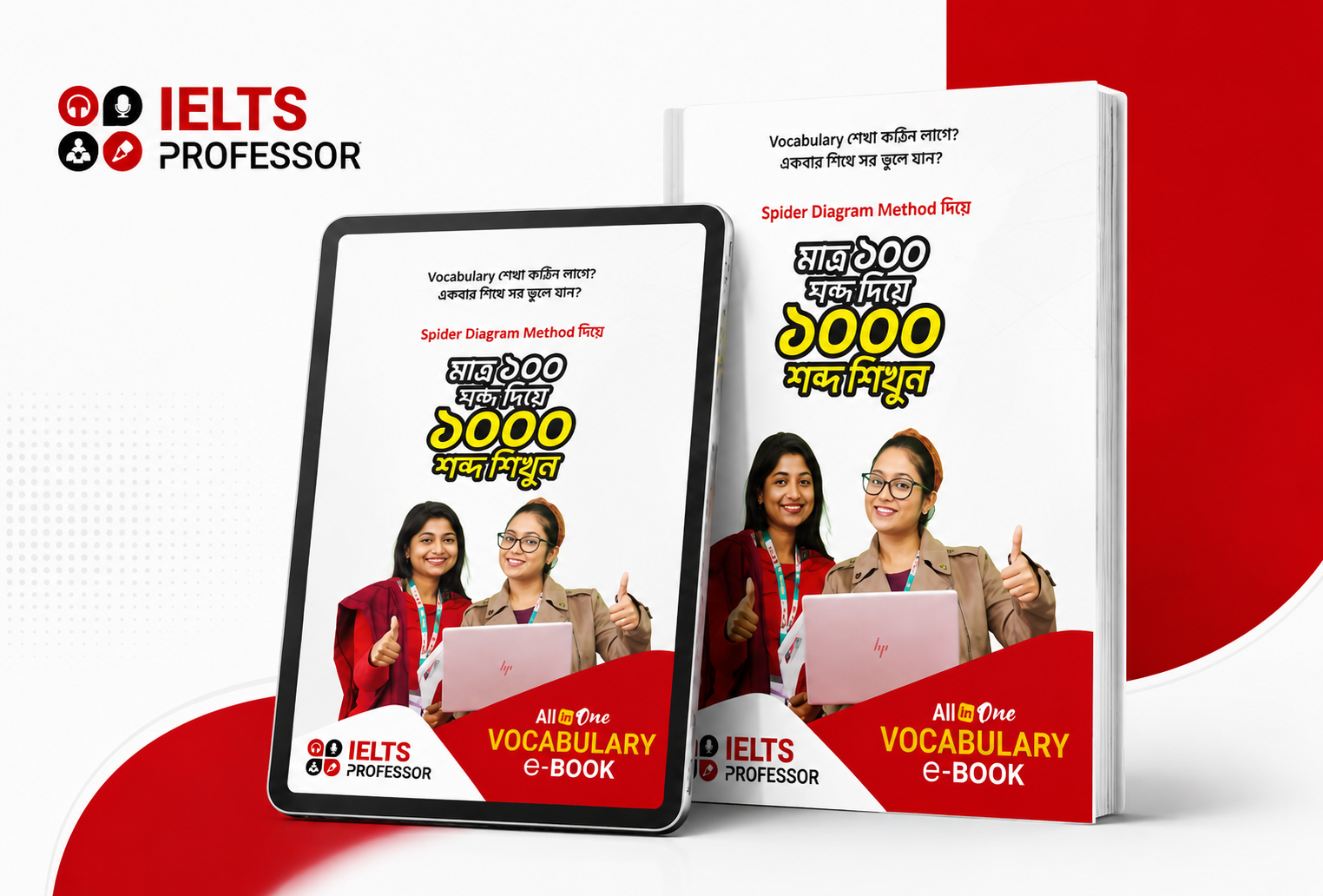
All in One Vocabulary
৳ 249.00

Premium 7+ IELTS Offline
৳ 14000.00