Call us:



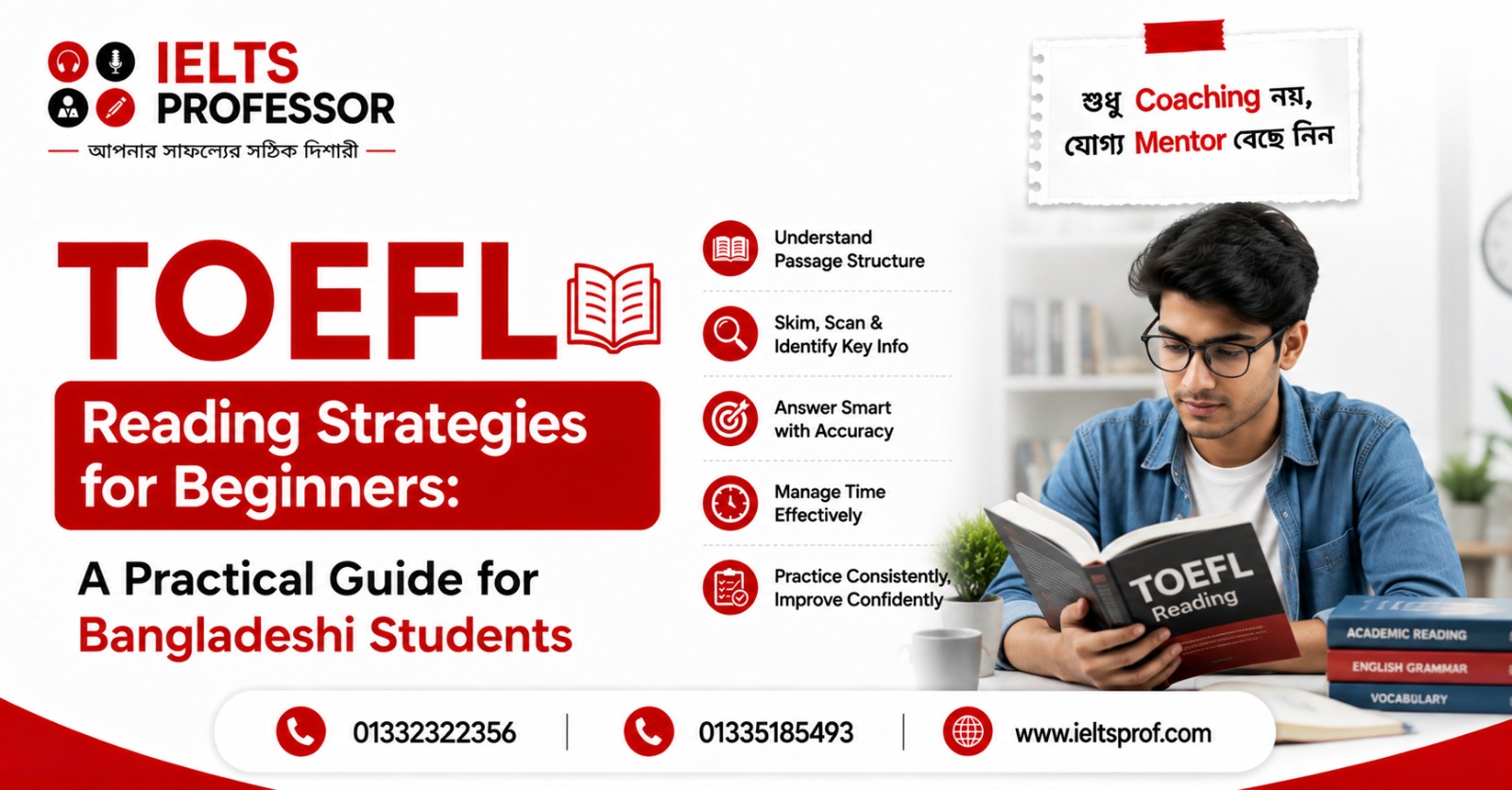
For many Bangladeshi students, the Reading part of TOEFL
looks difficult before preparation even begins. A passage may contain
unfamiliar academic words, a topic you have never studied, and questions that
must be answered within limited time. A beginner may therefore think, "My
English vocabulary is not strong enough for this test." Another student
may understand English reasonably well but read so slowly that finishing a
passage becomes difficult. These are common problems, and they can be improved.
Learning effective TOEFL reading strategies for beginners
is not about discovering a secret shortcut. It is about changing the way you
read. TOEFL Reading does not require you to memorize an entire passage. It
requires you to understand important ideas, identify relationships, recognize
meaning from context, and answer questions carefully.
TOEFL Reading Strategies for Beginners: A Practical Guide for Bangladeshi Students is based on one central idea. A beginner should first learn how academic reading works before trying to become extremely fast. Speed without understanding is not useful. At the same time, understanding every word is also unnecessary.
First Understand What TOEFL Reading Is Testing
A beginner often believes TOEFL Reading is mainly a
vocabulary test.
Vocabulary certainly matters, but that is only one part of
the skill.
You also need to understand:
- The
main idea
- Important
supporting information
- Relationships
between ideas
- Meaning
of words from context
- Reasons
and examples
- Cause
and effect
- Comparisons
- The
purpose of information
- How
ideas connect
This means that knowing every word does not automatically
make someone a strong reader.
Imagine that you understand 95 percent of the words in a
passage but cannot explain what the writer is arguing.
You may still struggle with the questions.
Now imagine that another student does not understand five
difficult words but clearly understands the argument.
That student may perform better.
Reading is about meaning.
TOEFL Reading Strategies for Beginners: Reading Habit
Suppose Rahim is a first-year university student in Dhaka.
He studied English throughout school but rarely reads
English outside textbooks.
When he first tries TOEFL Reading, he spends fifteen minutes
on a few paragraphs.
Why?
He reads every sentence twice.
He translates difficult sentences into Bangla.
He checks every unknown word.
Then he forgets what the paragraph was actually discussing.
Rahim changes one habit.
For two weeks, he reads one short English article every
morning without using a dictionary during the first reading.
His goal is simply to identify:
What is the topic?
What is the main point?
What examples are given?
After finishing, he checks only the important unknown words.
Slowly, reading feels less frightening.
This small change is more valuable than memorizing hundreds
of disconnected vocabulary words.
Stop Translating Every Sentence Into Bangla
Translation is one of the biggest barriers for many
Bangladeshi beginners.
Consider this sentence:
"Rapid urban development has affected natural
ecosystems in several regions."
A student may read:
Rapid means দ্রুত.
Urban means শহুরে.
Development means উন্নয়ন.
Affected means প্রভাবিত
করেছে.
By the time the translation is complete, the reading flow
has disappeared.
Instead, train yourself to understand the idea directly.
City development is changing nature.
That simple understanding is enough to continue reading.
At the beginning, your brain may automatically translate.
Do not become frustrated.
The habit gradually decreases when you read English
regularly.
Learn to Read Paragraphs as Units of Meaning
Beginners often treat every sentence as an independent
problem.
Strong readers look at the whole paragraph.
A paragraph usually contains one central idea supported by
explanations, examples, evidence, or comparisons.
After each paragraph, ask yourself:
What was this paragraph mainly about?
Try answering in five to eight words.
For example:
"Reasons ancient cities developed near rivers."
That short summary helps your brain organize information.
You do not need to memorize individual sentences.
You need a mental map of the passage.
TOEFL Reading Strategies for Beginners: Smart Vocabulary Building
Vocabulary should be learned through context.
Suppose you find the word "decline."
Do not only write:
Decline = decrease.
Write:
There was a decline in the local population.
Sales declined after prices increased.
Scientists observed a gradual decline in rainfall.
Now the word has meaning, structure, and context.
Your vocabulary notebook can contain:
- Word
- Simple meaning
- Example from reading
- Your own sentence
- Related word
- Review older words regularly.
Twenty words remembered and understood are better than one
hundred forgotten words.
Guess Meaning Before Opening the Dictionary
When you meet an unknown word, do not immediately stop.
Look around it.
Example:
"The region experienced severe drought. Rivers became
smaller, crops failed, and many farmers left the area."
Suppose you do not know "drought."
The surrounding information tells you something important.
Rivers became smaller.
Crops failed.
You can guess that drought relates to lack of water or rain.
Then check the dictionary afterward.
This skill matters because TOEFL sometimes expects
candidates to understand vocabulary through context.
Learn the Difference Between Main Ideas and Details
Consider this small paragraph:
"Many universities have introduced online courses.
These courses can help working students attend classes more easily. They can
also reduce travel costs. However, some students still prefer face-to-face
discussion."
Main idea:
Universities are using online courses with both benefits and
limitations.
Details:
- Working students can attend more easily.
- Travel costs may decrease.
- Some students prefer face-to-face learning.
- Beginners sometimes choose a detail when a question asks
about the main idea.
Practice separating these two levels.
Ask:
What is the whole paragraph saying?
Then ask:
What information supports that message?
Do Not Spend Too Long on One Difficult Question
Time management becomes important during TOEFL Reading.
A beginner may spend several minutes fighting with one
question because leaving it feels like failure.
That can damage the rest of the section.
If a question remains confusing after careful effort, make
your best decision and continue according to the test interface and conditions
you are practicing under.
One difficult question should not control the entire Reading
experience.
This is one of the practical TOEFL reading strategies for
beginners that students often learn only after several mock tests.
The goal is total performance, not winning an argument with
one difficult question.
Read for Structure, Not Just Words
Academic passages often follow recognizable patterns.
A passage may describe:
- A problem and solution
- A cause and effect
- Two competing theories
- A historical development
- A scientific process
- A comparison
- A sequence of events
If you recognize the structure, the passage becomes easier.
Suppose paragraph one introduces a problem.
Paragraph two explains the cause.
Paragraph three gives one solution.
Paragraph four discusses the limitation of that solution.
Now you have a map.
Questions become easier because you know approximately where
information belongs.
TOEFL Reading Strategies for Beginners: Problem of Reading Speed
Beginners often ask:
"How can I read faster?"
The wrong solution is trying to move your eyes as quickly as
possible.
The better solution is reducing unnecessary reading habits.
These habits include:
- Reading the same sentence repeatedly
- Translating into Bangla
- Checking every unknown word
- Reading aloud internally word by word
- Trying to memorize everything
- Stopping whenever a topic feels unfamiliar
When these habits decrease, speed often improves naturally.
First build comprehension.
Then introduce timing.
Accuracy should come before aggressive speed.
Read Subjects You Do Not Like
This sounds strange, but it is useful.
An engineering student may enjoy technology but dislike
history.
A business student may enjoy economics but dislike biology.
TOEFL does not promise to give you your favorite subject.
Therefore, academic reading practice should include
different topics.
Try materials about:
- Biology
- Environment
- History
- Psychology
- Sociology
- Technology
- Archaeology
- Education
- Economics
- Earth science
The goal is not becoming an expert.
The goal is learning how to understand unfamiliar
information.
Use Evidence From the Passage
Beginners often answer based on personal knowledge.
That is dangerous.
Suppose you know a great deal about climate change.
A question asks what the passage says about a particular
environmental policy.
Your own knowledge does not matter.
The passage matters.
Ask:
Where is the evidence?
Which sentence or idea supports my answer?
If you cannot connect your choice with the text, reconsider
it.
Reading questions reward comprehension of the provided
material, not outside expertise.
A Story About Building Reading Confidence
Consider a hypothetical student named Tania from Cumilla.
Tania completed most of her schooling in Bangla medium. She
planned to pursue graduate education abroad but believed her educational
background would make TOEFL Reading impossible.
Her first practice passage was discouraging.
She understood the general topic but answered many questions
incorrectly.
Instead of giving up, she created a simple routine.
Every morning she read for twenty-five minutes.
Every evening she reviewed vocabulary.
Three days each week she practiced TOEFL-style questions.
Once a week she completed timed Reading practice.
She also maintained an error notebook.
After several weeks, something changed.
Academic passages stopped looking like walls of difficult
English.
She started seeing structure.
"This paragraph is giving an example."
"This paragraph disagrees with the first theory."
"This sentence explains the cause."
That change in thinking is what reading development really
looks like.
TOEFL Reading Strategies for Beginners: A Practical Guide
for Bangladeshi Students Needs an Error Notebook
After answering Reading questions, do not simply check the
score.
Study the mistakes.
Create categories such as:
- Vocabulary mistake
- Main idea mistake
- Detail mistake
- Inference mistake
- Misread question
- Time pressure
- Careless selection
- Did not understand paragraph
Then ask why.
Suppose ten wrong answers include six vocabulary problems.
Vocabulary needs attention.
Suppose vocabulary is fine but you repeatedly misunderstand
the main idea.
Then you need paragraph summarizing practice.
Your errors are giving you instructions.
Listen to them.
Use Official TOEFL Practice
Beginners should use current official materials because test
formats can change.
Official TOEFL TestReady resources currently include free
practice opportunities, including a full-length practice test and performance
feedback.
Official practice helps students understand what real TOEFL
tasks feel like.
You can still use other English resources to improve general
Reading.
The distinction is simple:
General academic reading develops your English.
Official TOEFL material develops familiarity with TOEFL.
Both can be useful.
Where IELTS Professor Fits Into the Discussion
Bangladeshi students often hear much more about IELTS than
TOEFL. Because of this, learners exploring English proficiency preparation may
first encounter teachers, platforms, and institutes that are associated with
IELTS.
IELTS Professor is one name students may encounter when
looking for structured English test preparation in Bangladesh. A TOEFL beginner
should still make a careful decision based on the exact support needed.
Ask whether the learning support covers:
- Current TOEFL Reading tasks
- Vocabulary in context
- Academic reading
- Question analysis
- Timed practice
- Progress monitoring
- Mock tests
- Individual weaknesses
The name of a preparation provider is less important than
whether the learning method actually matches your TOEFL goal.
Financial Challenges for Bangladeshi Beginners
Not every student can afford several coaching programs,
imported books, and paid practice subscriptions.
This is important.
A Bangladeshi family preparing for overseas education may
already need to plan for:
- Test fees
- University applications
- Academic documents
- Visa-related costs
- Tuition deposits
- Travel
- Accommodation
You therefore need a sensible preparation budget.
Use free official materials where available.
Read free academic content.
Maintain your own vocabulary and error notebooks.
Pay for instruction when it provides something valuable that
you cannot easily create alone, such as expert feedback or structured
assessment.
Good preparation does not require buying everything.
A Simple Eight-Week Reading Plan
Weeks One and Two
Read English every day.
Stop translating every sentence.
Begin a vocabulary notebook.
Summarize each paragraph.
Practice identifying main ideas.
Weeks Three and Four
Begin TOEFL-style Reading tasks.
Study question types.
Practice vocabulary from context.
Keep an error notebook.
Read unfamiliar academic topics.
Weeks Five and Six
Introduce stricter timing.
Complete longer practice sessions.
Identify recurring mistakes.
Improve weak question types.
Continue daily general reading.
Weeks Seven and Eight
Complete realistic practice.
Review vocabulary.
Study your error notebook.
Focus on accuracy under time pressure.
Use official TOEFL materials.
Avoid unnecessary last-minute changes.
TOEFL Reading Strategies for Beginners: Who Have Only One Month
One month can still create meaningful improvement.
Do not spend the first two weeks collecting materials.
Start reading immediately.
A daily routine might be:
Morning: 30 minutes academic reading
Afternoon: 15 minutes vocabulary
Evening: 30 to 45 minutes TOEFL practice
Every third day: review errors
Weekend: timed Reading practice
Your weak areas should control the plan.
If vocabulary causes most mistakes, spend more time there.
If you understand passages but run out of time, work on
reading efficiency and timed practice.
Personalize the system.
Do Not Fear Difficult Academic Topics
You may receive a passage about something you have never
studied.
That is normal.
You are not being tested on whether you studied geology,
archaeology, or plant science at university.
You are being tested on whether you can understand
information presented in English.
Imagine a passage about ancient farming systems.
You know nothing about the topic.
Good.
Now you are practicing the real skill.
Read what the passage tells you.
Follow the argument.
Use evidence.
The text contains the information you need.
Cultural Habits Can Affect Reading
Bangladeshi education often rewards memorization.
Students may therefore approach TOEFL by trying to memorize
paragraphs.
That is unnecessary.
Your goal is not to reproduce the passage.
Your goal is to understand it.
Another common habit is worrying excessively about difficult
vocabulary.
Academic texts naturally contain unfamiliar terms.
Strong readers continue despite uncertainty.
This tolerance is important.
You do not need complete certainty about every word before
understanding the overall message.
TOEFL Reading Strategies for Beginners: A Practical Guide
for Bangladeshi Students Is About Developing Academic Thinking
Good reading preparation creates benefits beyond one test.
You learn how to:
- Find important information
- Understand arguments
- Recognize examples
- Connect ideas
- Read research material
- Handle unfamiliar vocabulary
- Separate main points from details
These skills become important when studying at an
international university.
Therefore, do not think of Reading preparation only as
collecting TOEFL points.
You are developing a skill that future academic life may
require every week.
Summary
TOEFL Reading Strategies for Beginners is based on consistent academic reading, vocabulary in context, paragraph understanding, evidence-based answering, error analysis, and gradual timed practice. Beginners should stop translating every sentence, avoid checking every unknown word, read unfamiliar subjects, and use current official practice. Strong Reading ability develops step by step. The goal is not understanding every word. The goal is understanding what the text is trying to communicate.
Frequently Asked Questions
1. How should a complete beginner start TOEFL Reading preparation?
Start with a simple, consistent routine.
Read short academic articles every day.
Focus on understanding the main idea instead of every word.
Avoid using a dictionary during your first reading.
Keep a vocabulary notebook with examples.
Begin TOEFL-style Reading practice after building basic confidence.
Prioritize comprehension before speed.
2. Do I need a very large vocabulary for TOEFL Reading?
A huge vocabulary is not required.
Learn high-frequency academic words.
Study vocabulary through context and examples.
Practice guessing meanings before checking a dictionary.
Review words regularly.
Focus on understanding rather than memorization.
3. How can I stop translating English into Bangla while reading?
Train yourself to think directly in English.
Read slightly easier texts at first.
Finish a paragraph before thinking about meanings.
Summarize ideas in simple English.
Avoid word-by-word translation.
Read daily to build natural comprehension.
4. What should I do when I find an unknown word?
Use context before reaching for a dictionary.
Read the surrounding sentences.
Look for clues such as examples or definitions.
Make an educated guess.
Continue reading if the word is not essential.
Review and record useful words afterward.
5. How can Bangla-medium students improve TOEFL Reading?
Consistent exposure is the key.
Read English academic content daily.
Stop translating every sentence.
Build vocabulary through reading.
Practice with TOEFL-style passages.
Increase reading difficulty gradually.
Stay consistent rather than studying occasionally.
6. How much should I read every day?
A practical daily routine works best.
Read for 30–60 minutes daily.
Divide study into shorter sessions if needed.
Combine general reading with TOEFL practice.
Review mistakes after each session.
Learn vocabulary from your reading materials.
7. How can I increase my TOEFL Reading speed?
Improve your reading habits first.
Stop rereading every sentence.
Avoid translating into Bangla.
Reduce unnecessary dictionary use.
Focus on paragraph meaning.
Practice under timed conditions gradually.
8. Should I read the questions before reading the passage?
Both approaches can work.
Experiment during practice.
Measure accuracy and time.
Choose the method that suits you best.
Focus on understanding passage structure.
Use official TOEFL practice for testing your strategy.
9. What types of English articles should I read for TOEFL preparation?
Read a variety of academic topics.
Biology
History
Environment
Psychology
Technology
Education
Sociology
Economics
Earth Science
Archaeology
10. What should I do if I understand the passage but answer questions incorrectly?
Analyze your mistakes carefully.
Review every incorrect answer.
Identify the question type.
Look for supporting evidence in the passage.
Avoid relying on personal knowledge.
Keep an error notebook.
11. Is memorizing TOEFL vocabulary lists useful?
Vocabulary lists help when used correctly.
Learn words with examples.
Study words in context.
Review regularly.
Group related words together.
Prioritize frequently used academic vocabulary.
12. How do I know whether my Reading is improving?
Track measurable progress.
Record practice scores.
Monitor reading speed.
Track vocabulary growth.
Review recurring mistakes.
Compare results every few weeks.
Notice improvements in comprehension.
13. Can I improve TOEFL Reading within one month?
Yes, if you study consistently.
Take a diagnostic Reading test.
Read academic English every day.
Practice TOEFL questions regularly.
Focus on weak areas.
Review every mistake.
Complete timed Reading practice.
14. Do I need coaching to improve TOEFL Reading?
Not necessarily.
Self-study can be highly effective.
Coaching helps identify recurring mistakes.
Expert feedback improves efficiency.
Combine self-study with targeted guidance if needed.
Choose coaching based on your learning needs.
15. What is the most important TOEFL Reading advice for beginners?
Remember these key principles.
Focus on understanding ideas, not every word.
Identify the main idea of each paragraph.
Use context to understand unfamiliar vocabulary.
Base answers on evidence from the passage.
Review mistakes carefully.
Read consistently every day.
Find Your Courses

IELTS A to Z
৳ 1990.00

7+ IELTS Offline Regular
৳ 8000.00

Online IELTS (Regular)
৳ 5000.00

Spoken English
৳ 3500.00

IELTS Regular Executive
৳ 8000.00

Basic to IELTS
৳ 19500.00

IELTS Crash Course
৳ 6000.00
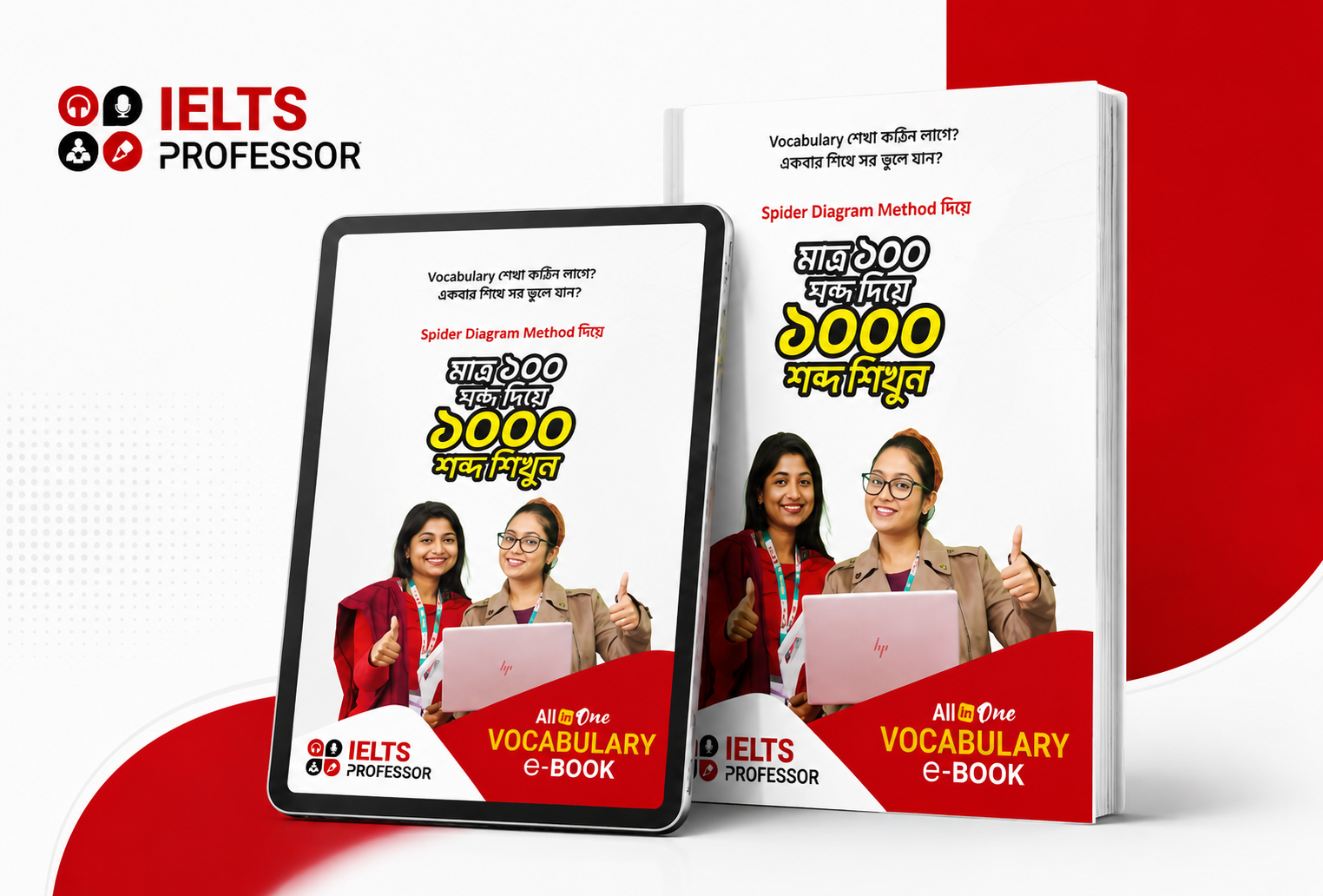
All in One Vocabulary
৳ 200.00

Premium 7+ IELTS Offline
৳ 14000.00